
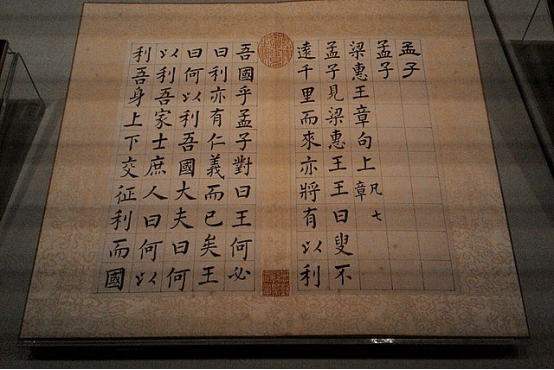
The Mencius is a crucial text in the Confucian system, connecting past and future generations. It inherits Confucius’s philosophy of benevolence while also offering deeper reflections on politics and human nature. Mencius’s concept of benevolent government is not merely a philosophy of political governance but also an idealistic humanistic conviction—it places the people at the center of politics and considers morality and responsibility the foundation of governance. During the Warring States period, a period of frequent wars and power struggles, Mencius championed the concept of benevolent government, expressing both a critique of current politics and an aspiration for an ideal society. Underpinning this ideal was the unique spiritual commitment of the scholar class: they prioritized morality over material gain, linking personal cultivation with the well-being of the world.
1. The Core of “Benevolent Government”: A People-Oriented Humanistic Ideal
The core of Mencius’s philosophy of benevolent government is “putting the people first.” In “Mencius: The Doctrine of the Mean, Part One,” he stated: “The people are the most important, the state and the altar are second, and the ruler is the least important.” This statement is considered one of the most revolutionary statements in the history of Chinese political thought. It was the first to clearly state that political power should serve the people, rather than the people obeying power. This people-centered philosophy undermined the monarchy’s concept of absolute authority and provided a deeply humanistic direction for subsequent political philosophy.
Mencius believed that true politics should be rooted in benevolence, not abstract charity but tangible care and good governance. Benevolent governance meant ensuring that the elderly had a proper place to live, the able-bodied had employment, the young had opportunities for growth, and the widowed, the orphaned, and the lonely were all provided for. This political ideal reflected Mencius’s deep trust and respect for human nature. He believed that human nature is inherently good, and that as long as rulers implemented benevolent policies and cultivated virtue, people’s hearts would naturally be drawn to goodness, and society would return to harmony.
From today’s perspective, Mencius’s concept of “benevolent government” possesses universal significance that transcends time. It is not only a political ideal but also a humanistic philosophy. In modern democratic societies, “government serving the people” has become a universal value, yet Mencius proposed similar concepts over two thousand years ago. At the core of this philosophy lies not a struggle for power but respect for the dignity of life and the pursuit of social justice.
For American readers, Mencius’s “benevolent government” can be understood as an ancient Eastern humanistic political perspective. It emphasizes not institutional conflict but the unity of moral leadership and public responsibility. Mencius’s statement, “He who wins the hearts of the people wins the world,” bears resemblance to the “social contract” theory in Western political philosophy: power must be based on the recognition and trust of the people. This cross-cultural resonance is precisely the value of Confucianism in human civilization.
II. Human Nature and Politics: From the Theory of Human Goodness to Moral Governance
Mencius’s thesis that “human nature is inherently good” formed the foundation of his political philosophy. Unlike his contemporaries, such as the Legalist scholars Xunzi and Han Feizi, Mencius did not believe that order needed to be maintained through coercion and punishment. Instead, he advocated for cultivating people through virtue and guiding them through education. He believed that deep within every human being lies a heart of compassion, a kind of goodwill that is the starting point of universal human morality.
In Mencius’ Gaozi (Part 1), he wrote: “The heart of compassion is in everyone; the heart of shame and disgust is in everyone; the heart of courtesy and humility is in everyone; and the heart of right and wrong is in everyone.” These four core values are the source of benevolence, righteousness, propriety, and wisdom. Through this discourse, Mencius established the inherent connection between politics and morality—the foundation of politics lies not in the mechanisms of power but in the goodwill and awakening of the human heart.
This philosophy remains profoundly inspiring in contemporary society. In a modern world where power and capital are constantly expanding, Mencius’s theory of human nature reminds us that true social governance should not rely solely on institutional constraints but should also stimulate human conscience. The purpose of politics is not to suppress human nature but to guide goodwill so that it becomes the inherent force of social order.
Mencius’s thought also possessed a practical and critical perspective. He opposed rulers who ruled with tyranny and maintained rule through fear. In “The King Hui of Liang, Part I,” he bluntly stated, “In a year when the king is free from sin, the people of the whole world will flock to him.” His implication was that if a monarch could govern his people with benevolence, the people would naturally flock to him. This belief was not naive idealism, but rather grounded in a profound insight into human nature. Mencius understood that humans yearn to be respected and understood, and when rulers provide this care, social cohesion naturally arises without coercion.
3. The Spiritual Responsibility of Scholars: Morality is More Important than Fame
Mencius was not only a thinker but also a model scholar. Amidst the turbulent times of the Warring States Period, he upheld morality and righteousness, steadfastly adhering to principles and unwavering in his resolve to be powerful and unyielding to personal gain. His spirit of responsibility has become a symbol of Chinese scholar culture and has shaped the moral ideals of intellectuals for millennia.
In “Mencius: Duke Wen of Teng, Part 2,” he wrote: “Wealth and honor cannot corrupt, poverty and humbleness cannot move, power and force cannot bend; this is what is called a true man.” This statement has become the highest expression of the Chinese ideal of personality. Mencius believed that a true scholar should be rooted in morality and righteousness, and should never abandon his inner justice and convictions, regardless of external circumstances.
This scholarly spirit holds a crucial place in Confucian culture. It’s not just a personal virtue, but also a social responsibility. Mencius believed that scholars were not tools serving the monarch, but rather guardians of society’s conscience. When politics goes astray, scholars should step forward, offering rational advice and undeterred by power. This spirit has long endowed Chinese intellectuals with a sense of mission to “correct the times with virtue.”
If we apply Mencius’s spirit of scholarliness to a modern context, it remains universally relevant. In today’s society, whether politicians, scholars, or ordinary citizens, maintaining conscience and independent judgment in a complex environment is a daunting challenge. Mencius’s thinking teaches us that true courage lies not in power but in upholding justice; true success lies not in status but in living up to one’s conscience.
For American readers, this scholarly spirit can be understood as a kind of “moral courage,” a moral courage that transcends personal interests. In public life, this courage manifests itself in the pursuit of truth, compassion for the vulnerable, and resistance to injustice. Mencius’ ideals are not only political ideals, but also personal ideals.
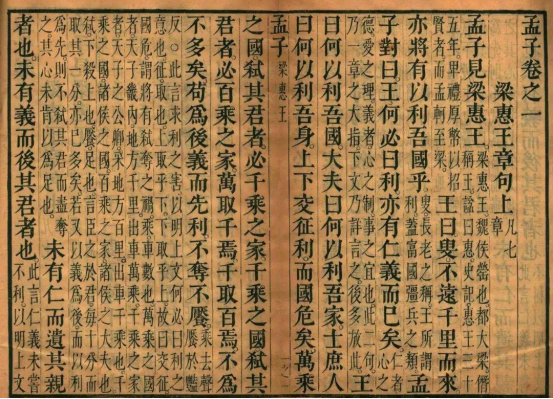
IV. The Contemporary Enlightenment of the Ideal of “Benevolent Government”
Although Mencius lived over two thousand years ago, his philosophy of benevolent government still offers valuable insights for contemporary society. Despite the complex institutions and technologies of modern politics, the core question of human society remains: how to make power serve the people, rather than the other way around. Mencius’s answer remains clear: benevolence is the foundation, and virtue is paramount.
In today’s world of globalization and social division, “benevolent governance” is not only a political philosophy but also a form of cultural healing. It reminds us that the essence of governance lies in understanding and care, not confrontation and conquest. Whether national leaders or corporate managers, if they act with the spirit of “benevolence,” judge with the principles of “righteousness,” and treat others with “trust,” the cohesion of society and organizations will far outweigh any institutional constraints.
Furthermore, Mencius’s thought offers a complementary perspective for modern democratic politics. Western political systems emphasize checks and balances and institutional safeguards, while Confucian “benevolent government” emphasizes moral consciousness and ethical responsibility. Combining the two might foster a more comprehensive concept of humanistic governance: institutions constrain power, while morality guides behavior.
From a personal perspective, Mencius’s teachings are equally relevant. His advocacy of “cultivating oneself and establishing virtue” applies not only to ancient scholars but also to modern civil society. Regardless of the society in which one lives, everyone can contribute to the community through self-cultivation and just action.
5. Conclusion: The light of ideals illuminates people’s hearts
The concept of benevolent government in Mencius is one of the most gentle yet tenacious ideals in ancient Chinese political philosophy. Starting from the goodness of human nature and guided by a sense of morality, it depicts an ideal society centered on the people and prioritizing virtue. Mencius’s greatness lies not only in his courage to advocate for benevolence and righteousness in troubled times, but also in his belief that even in times of darkness, light still lingers in the human heart.
Today, we can still draw strength from Mencius’s thought. Whether it’s personal moral choices or the political direction of society, they are inseparable from the warmth of “benevolent government” and the responsibility of scholars. As Mencius said, “If you are poor, you should improve yourself; if you are rich, you should help the world.” This is the character of the scholar and the hope of human civilization.
Mencius used his thoughts to teach the world: ideals are not out of reach; they exist within the heart of every person with a conscience. Only when people are rooted in benevolence can society value harmony; only when scholars are courageous and responsible can civilization continue to advance. More than two thousand years later, Mencius’s voice still resonates—a call for justice, a conviction that upholds morality, and an unquenchable light of ideals.