
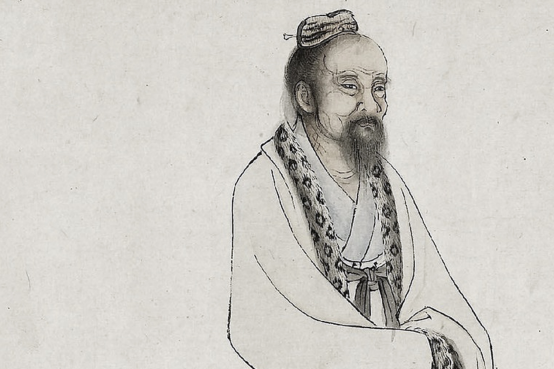
Zhuangzi is a work of remarkable imagination and philosophical depth in the history of ancient Chinese thought. It not only continues the spiritual tradition of Taoist thought but also integrates philosophy and literature to form a unique poetic and philosophical discourse. The opening chapter, “Xiaoyaoyou,” is arguably the most liberating chapter in Chinese intellectual history. With its romantic imagination and transcendental philosophy, it constructs an ideal realm of spiritual freedom, transcending worldly constraints. For modern people, Zhuangzi’s “Xiaoyaoyou” is not only a philosophical reflection but also a spiritual call, inviting us to transcend utilitarianism and anxiety and rediscover the poetry and freedom of life.
1. The original meaning of Xiaoyao: the spirit of freedom that transcends constraints
The three characters “Xiao Yao You” (free and unrestrained) appear light-hearted, yet they contain profound philosophical connotations. “Xiao Yao” (free and unrestrained) does not simply mean idleness or inaction, but rather a state of mind that transcends external constraints and embraces inner freedom. In Zhuangzi’s “Xiao Yao You,” Zhuangzi opens with the fantastical allegory of “Kun Peng transforming into a feather”: “In the North Sea there is a fish named Kun. Kun is so vast, no one knows how many thousands of miles it spans. It transforms into a bird named Peng.” The Kun Peng spreads its wings for 90,000 miles, soaring into the heavens. This is not only a stunning depiction of natural imagination but also a symbolic expression of spiritual freedom.
Through this mythological narrative, Zhuangzi expresses his reflections on the finite and the infinite. He sees life’s suffering as stemming from constraints—they are bound by fame and fortune, by success and failure, and by worldly expectations. The ideal state of “freedom” lies in shedding these constraints, allowing the soul to freely roam the vast universe. The essence of freedom lies in spiritual independence and transcendence, a clear mindset that “is neither pleased by material things nor saddened by oneself.”
Compared to the concept of “freedom” in Western philosophy, Zhuangzi’s “freedom” leans more towards inner liberation than external power. It’s not about changing the world, but about transcending it; not about conquering nature, but about conforming to it. This philosophy shares similarities with the ancient Greek Stoics—both emphasize achieving a detached attitude towards fate through inner spiritual freedom. However, Zhuangzi’s freedom is characterized by a poetic flexibility and an Eastern ethereal quality. Rather than pursuing rational control, he embraces all things through a spirit of “wuwei,” achieving unity with the Tao.
2. The Philosophical Realm of Freedom: From Relative to Absolute Freedom
Zhuangzi’s “freedom” wasn’t a momentary escape; it was a philosophical elevation from relative existence to absolute freedom. In “Xiaoyaoyou,” he proposed the idea that “the most perfect man has no self, the divine man has no merit, and the sage has no name.” This statement reveals his layered understanding of life. “No self” refers to shedding egocentrism; “no merit” refers to not clinging to achievement; and “no name” refers to not being trapped by reputation. Only when a person completely transcends utilitarianism and gains and losses can one truly achieve spiritual freedom.
Zhuangzi believed that all things in the world have no fixed boundaries. So-called nobility, inferiority, greatness, right and wrong are all created by the human mind. As he put it, “That is also right and wrong; this is also right and wrong.” In a relative world, clinging to one side of the world is trapped by opposition. Only by transcending relativity can one achieve the state of “equality of all things”—a free state of mind in which all things are equal and without distinction. This thought is not only a metaphysical philosophical speculation, but also a profound existential experience.
In modern society, people are often constrained by roles, responsibilities, and expectations, their lives defined by external factors. Zhuangzi’s philosophy reminds us that true freedom lies not in escaping society but in maintaining spiritual self-mastery within it. Only when a person is unaffected by circumstances, unmoored by judgments, and unconsumed by desire can one truly experience the meaning of “freedom.” This kind of freedom is a kind of “inner tranquility,” a state of mind as still as still water.
For American readers, Zhuangzi’s “Xiaoyaoyou” can be seen as an Eastern version of transcendentalism. It resonates with the ideas of Emerson and Thoreau: people should return to nature, listen to their hearts, and achieve true spiritual independence. However, Zhuangzi’s freedom is more metaphysically harmonious—he does not advocate resisting the world, but rather achieving a higher level of freedom by conforming to the Dao and becoming part of the rhythm of the universe.
3. Xiaoyao’s Poetic Expression: The Artistic Power of Fable and Imagination
The appeal of Zhuangzi lies not only in its profound philosophy but also in the poetic quality of its text and the vastness of its imagination. Zhuangzi does not expound his ideas through abstract argumentation, but rather through literary devices such as parable, metaphor, and fantasy, allowing philosophy to flourish within the poetic realm. The transformation of Kunpeng in “Xiaoyaoyou,” the dialogue between the cicada and the dove, and the debate between Huizi and Zhuangzi are all rich in literary tension and philosophical allusions.
Zhuangzi’s language is like the wind, ethereal yet full of the fluidity of life. He uses fantastical imagery to express profound wisdom, transforming philosophy from aridity into an artistic experience. For example, when Zhuangzi says, “Liezi rode the wind and returned after ten days and fifteen days. He who seeks happiness does not count,” this is not only a transcendental imagination of time and space but also a metaphor for spiritual freedom. Those who ride the wind do not rely on their own strength but rather follow the flow of nature, a true embodiment of the principle of “doing nothing and yet achieving everything.”
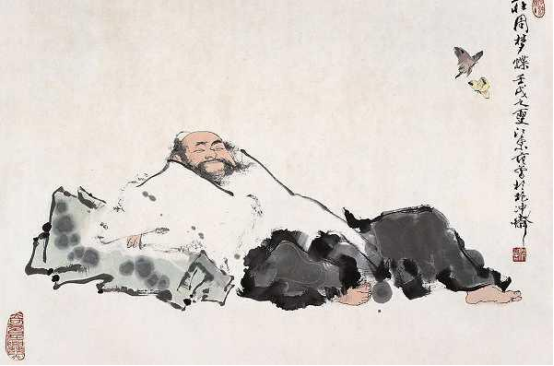
In Zhuangzi’s writings, philosophy is not a matter of logical deduction but a dance of the soul. He dissolves the boundaries between dream and wakefulness, fish and bird, and man and object, constructing a fluid and open universe. For example, the famous poem “Zhuang Zhou Dreams of the Butterfly” embodies this poetic philosophy to its highest degree: Zhuangzi dreams of himself as a butterfly, fluttering freely. Upon waking, he is unsure whether he dreamed of the butterfly or the butterfly dreamed of him. This ambiguity and transcendence reveals Zhuangzi’s profound reflections on the self and existence.
In Western literary tradition, poets often use symbols and metaphors to explore the meaning of existence, but Zhuangzi already accomplished this in an Eastern way. His writing is like an open poem, each sentence flowing through the boundaries of time and space, inspiring readers to enter into spiritual meditation while reading.
4. Freedom and Reality: Contemporary Enlightenment of Zhuangzi’s Thought
Zhuangzi’s ideas, seemingly detached from reality, offer profound insights into contemporary society. In today’s highly developed material world, humanity faces unprecedented anxiety and emptiness. Excessive competition, information overload, and social comparison have trapped many in a “defined life.” Zhuangzi’s “Xiao Yao You” offers a spiritual antidote—it reminds us that the meaning of life lies not in possessions but in living freely.
Zhuangzi was not a recluse escaping reality, but rather viewed the world from a higher perspective. His “freedom” (xiaoyao) was a kind of inner detachment, the ability to maintain self-clarity amidst chaos. Modern psychology emphasizes “mindfulness” and Zhuangzi’s “heart fasting” and “sitting and forgetting” practices, each embodying the restoration of spiritual freedom and balance through quieting the mind and letting go.
In the age of social media, where people chase fame, likes, and recognition, Zhuangzi reminds us: “Fame is the guest of reality.” Fame and fortune are but shadows; if we become trapped by them, we lose our essence. True happiness comes from peace of mind, from a sense of contentment unaffected by external judgment.
From a social perspective, Zhuangzi’s ideas also offer a new possibility for modern civilization. Faced with environmental crises and the challenges of technological ethics, Zhuangzi’s concept of “harmony between man and nature” reminds us that humans are not masters of nature, but rather a part of it. Reconsidering the relationship between man and nature through the lens of the Dao may lead to a new path between pursuing development and maintaining a balance.
5. Conclusion: The Poetry of Freedom and the Transcendence of Life
“Zhuangzi: Happy Journey” is a dialogue across time and the soul. It explores not a fantasy of escaping the mundane world but rather a spiritual elevation, a journey from the finite to the infinite. Zhuangzi expresses the deepest philosophical principles with the most romantic imagination and reveals the heaviest truths with the lightest language.
For us today, freedom doesn’t mean isolation, but rather an inner openness; it’s not a rejection of the world, but a flexible coexistence with it. As Zhuangzi said, “He who rides on the righteousness of heaven and earth, controls the interplay of the six vital energies, and roams the infinite—what else does he need?” True freedom doesn’t depend on external conditions, but rather stems from inner enlightenment.
More than two thousand years later, Zhuangzi’s thoughts remain like a refreshing breeze, sweeping away the world’s impetuousness and allowing us to rediscover the vastness and freedom of life. He teaches us to seek inner peace beyond fame and maintain a clear mind amidst chaos; he teaches us that freedom is not an escape, but a profound understanding and transcendence.
“Xiao Yao You” is not only a philosophical essay but also an eternal poem of life. It encourages us to believe that when the soul is unburdened by external things and when thoughts transcend the boundaries of utilitarianism, we can soar freely between heaven and earth, truly achieving the carefree state of “riding clouds and controlling flying dragons to roam beyond the four seas.”