
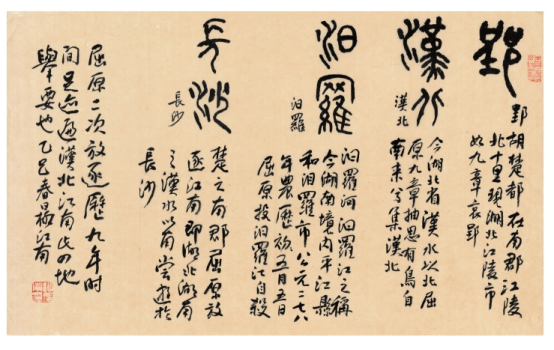
The Chuci is a magnificent masterpiece in the history of Chinese literature. With its unique regional style, profound emotion, and brilliant imagination, it pioneered a tradition of romanticism in later poetry. It is both the crystallization of Chu culture and the cry of the poets’ souls, and ultimately, the spiritual expression of ancient intellectuals facing political ideals and life’s predicaments. Unlike the simple and peaceful “Book of Songs,” the Chuci, with its intense emotions and magnificent imagery, showcases the unique character and spirit of the Chu region. Its core spiritual thread is precisely its cultural ethos, a fusion of patriotism, individual consciousness, and romantic ideals.
1. The Birth of Chuci and the Soul of Chu Culture
The Chu Ci originated in the Chu State during the Warring States Period, a land of vast geography, stunning landscapes, and a vibrant culture. The Chu region’s natural environment and mythological traditions fostered a unique aesthetic style. With its winding mountains and rivers, the vast Yangtze and Han Rivers, the prevalence of shamanism, and the abundance of rituals, the relationship between man and nature deepened into a close and mysterious one. This interweaving of geography and culture imbued the Chu people’s spiritual world with romance and imagination.
Against this cultural backdrop, the Chuci emerged. Represented by Qu Yuan, it absorbed elements of Chu folk songs, shamanic rhymes, and myths and legends, creating a new poetic style: the “Sao style.” This style, characterized by its free and unrestrained flow, flowing rhythm, musical language, and intensely sincere emotions, broke with the ritualistic and musical structure of the “Feng, Ya, and Song” sections of the Book of Songs and demonstrated the awakening of individual consciousness.
The Chu culture of Chu Ci is evident not only in its language and form, but also on a spiritual level. The Chu people valued emotions, dreams, and spirituality, pursuing a life experience that connects them to heaven and earth. These cultural traits imbue Chu Ci with a strong sense of individuality and cosmic sentiment—the poet is no longer merely a minister or priest, but a human being with thoughts and souls, independently facing heaven and earth and fate.
For modern readers, the allure of Chuci lies in its fusion of emotion and thought: intense feeling combined with profound philosophical principles, dissatisfaction with reality combined with a commitment to ideals. This spirit is extremely rare in both Eastern and Western literary traditions.
2. Qu Yuan’s Patriotism: The Resonance of Soul and Country
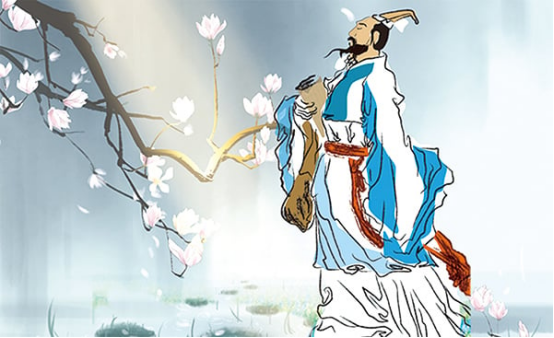
When discussing the Chu Ci, one cannot fail to mention Qu Yuan. As the soul of the Chu Ci, he closely linked his personal fate with the rise and fall of his nation, expressing his love for ideal politics and his grief over the corruption of the present through poetry. Qu Yuan’s poems are the cry of a thinker and the lament of a patriot.
In “Li Sao,” he poetically expounded on his loyal yet solitary political ideals. He wrote, “With a long sigh, I wipe away my tears, mourning the hardships of the people’s lives.” This is not only the lament of a frustrated politician, but also the compassion of a conscientious intellectual. Qu Yuan placed the fate of the people at heart and considered the future of his country his personal mission. His patriotism was not blind loyalty, but a rational commitment—he pursued political clarity and moral enlightenment.
Qu Yuan’s tragedy lies in his lofty ideals, yet his inability to change a corrupt reality; his loyalty to his country, yet his exile on the banks of the Yangtze and Xiang Rivers. This makes his patriotism all the more noble and tragic. His spirit of “never regretting even if faced with death nine times” has become a symbol of loyalty and idealism in Chinese culture.
From a modern perspective, Qu Yuan’s patriotism was not a narrow-minded national sentiment, but rather an extension of moral conviction. He integrated patriotism with a love of truth and justice. In today’s globalized world, this spirit remains valuable. It reminds us that true patriotism is not exclusive, but rather a safeguarding of social conscience and an adherence to shared values.
In the American cultural context, Qu Yuan’s spirit shares similarities with the idealism of thinkers like Ralph Emerson and Martin Luther King Jr.—all of them, centered on moral conviction, challenged the injustices of their times with their personal conscience. This commitment to “using poetry as a sword” has enabled the Chu Ci to transcend history and geography, becoming a symbol of the resonance of the human spirit.
3. Artistic Expression of Romantic Imagination: The Interweaving of Poetry and Dream
The artistic achievement of the Chuci lies not only in its profound thought but also in its romantic imagination and aesthetic creativity. Chuci poets such as Qu Yuan and Song Yu employed magnificent imagery, mythological language, and surreal scenes to construct a dreamlike world between the human world and the divine realm. There, the poets rode clouds and rainbows, traversed the vast wilderness, conversed with the gods, and journeyed with the heavens and the earth. This romantic spirit infused Chinese literature with boundless imagination for generations to come.
In “Li Sao,” Qu Yuan embodies a traveler pursuing his ideals, “riding a steed and galloping, I come to my path, the path that precedes it.” He traverses wind and cloud, visiting spirits and celestial realms, pursuing the eternally pure “good government” and “virtue.” This is not escape, but spiritual sublimation. Like the Romantic poets Shelley and Byron in Western literature, Qu Yuan used poetry as wings, allowing his ideals to survive in fantasy and his soul to find freedom in dreams.
In the imaginary world of “Chu Ci,” flowers, fragrances, wind, clouds, mountains, rivers, and magical beasts all possess personality and will. They dialogue with the poet, together forming a vibrant cosmic poetics. Unlike Western classical literature, which emphasizes rationality and order, the poetic quality of “Chu Ci” stems from the unrestrained emotion and the mysterious power of nature. This artistic spirit makes “Chu Ci” unique in world literature.
Furthermore, the language of “Chu Ci” is remarkably musical. The repetition of the character “兮” (xi) creates an undulating rhythm, reminiscent of the flow of a river or the echoing of a chant. This fluidity of language intensifies the poem’s emotional tension, bringing it closer to the intersection of music and dreams. For contemporary readers, “Chu Ci” is not only a reading experience, but also a spiritual immersion—it allows us to feel the warmth of the ancient people’s emotions and the vastness of their souls amidst its poetic melodies.
4. The Contemporary Significance of Chuci: A Combination of Romance and Faith
Although the Chuci was created over two thousand years ago, the emotions and spirit it expresses still resonate with modern people. In an era filled with realistic pressures and utilitarianism, the Chuci reminds us that ideals and romance are not illusory luxuries but an indispensable part of the human spirit.
Qu Yuan’s poetry teaches us that true romance isn’t about escaping reality, but about confronting desolation with poetry and corruption with conviction. Whether facing the political darkness of ancient Chu or the spiritual anxiety of modern society, poetry can be a force of resistance—it preserves the soul’s nobility and prevents thought from being assimilated.
For American readers, the significance of Chuci lies not only in the Eastern aesthetics it displays, but also in the universal spirit it conveys: the pursuit of truth, loyalty to justice, and the desire for freedom and dignity. This spirit transcends cultural boundaries and has become a common emotional language for humanity.
In the context of globalization, reading “Chu Ci” is a spiritual journey. It allows us to reinterpret the meaning of “homeland” and reexamine the relationship between the individual and the world. In Qu Yuan’s poetry, patriotism is not merely an emotional attachment but a responsibility of the soul; romance is not merely a soaring imagination but a commitment to ideals. This spiritual fire, transcending history, continues to illuminate hearts today.
5. Conclusion: Mountains and rivers are dreams, wind and rain are songs
Chuci is a book of the soul, embodying the spirit of the mountains and rivers of Chu and embodying humanity’s eternal pursuit of ideals and freedom. It shows us how a poet defies fate with words, transcends reality with imagination, and nourishes faith with emotion.
Poets like Qu Yuan, Song Yu, and Jia Yi, known for their Chuci, demonstrated with their lives that poetry is not only an art form but also a spiritual reality. When they sang, “The road ahead is long and arduous, I will search for it up and down,” their unyielding faith transcends time and becomes a spiritual symbol of Chinese culture.
The Chuci teaches us that true romance lies not in escape but in maintaining a pure soul in this world; true patriotism lies not in slogans but in upholding convictions with morality and responsibility. Just as the Chu winds are both gentle and fierce, and the Chu waters are both deep and far-reaching—that is the eternal power of poetry and faith.
In a turbulent world, the Chuci still reminds us with its song: poetry can redeem reality, and faith can transcend fate. When we read again the words, “Nine heavens clouds, I ride the wind,” we seem to hear Qu Yuan’s soul still on the river, chanting that immortal romance—an eternal song about the motherland, about ideals, and about the free soul.